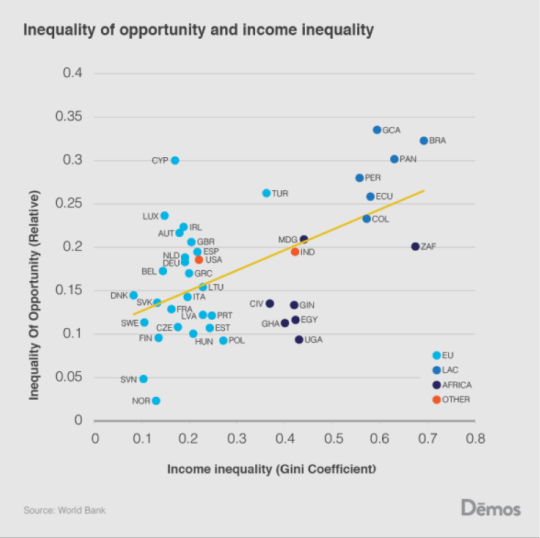
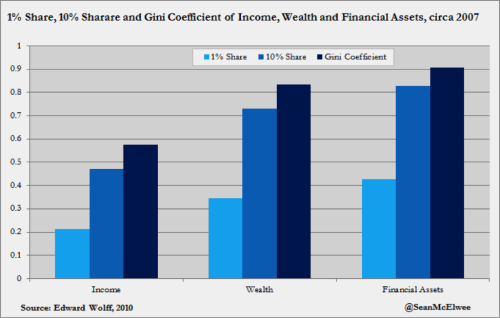
While much of the original research on inequality focused on how differences in income affected upward mobility (I covered that work extensively here), research has now also tackled the relationship between wealth and mobility. Gregory Clark, for example, findsthat wealth takes generations to dissipate. Meanwhile, W. Jean Yeung and Dalton Conleyfind that, “Liquid assets, particularly holdings in stocks or mutual funds, were positively associated with school-aged children’s test scores.” Another study, by Juan Rafael Morillas finds that the differences in earnings between black and white Americans “arises partly from the wealth inequality in assets ownership of blacks and whites.”
2) It decreases economic growth
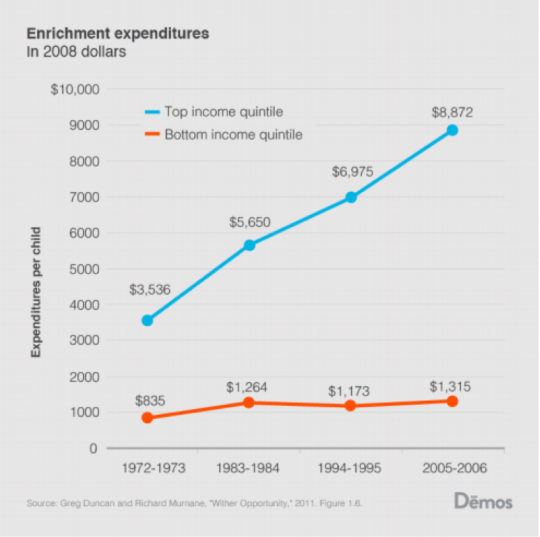
The implications of stalling upward mobility have implications for economic growth. When inequality presses down on opportunity, many low-income people can’t fully develop their capacities. As Stephen Jay Gould once noted, “I am, somehow, less interested in the weight and convolutions of Einstein’s brain than in the near certainty that people of equal talent have lived and died in cotton fields and sweatshops.” Today, even in a wealthy country like America, millions of bright young children have their cognitive development stunted by poverty. Wealthy parents invest heavily in their children, while low income families have less to spend. Further, as Miles Corak notes, the United States funds education at the local level, meaning that wealthier kids go to better schools than low-income kids.
Inequality also undermines democracy. As some individuals become increasingly powerful, they may use that influence to shift the political system. As Theodore Rooseveltonce noted, “The absence of effective state, and, especially, national, restraint upon unfair money-getting has tended to create a small class of enormously wealthy and economically powerful men, whose chief object is to hold and increase power.” As his cousin put it, “We know now that Government by organized money is just as dangerous as Government by organized mob.”
Last month I turned in my badge and my iPad at CFO.com, after a year plus slightly less than 6 months. A few days earlier, my then-girlfriend had been downsized from her company in a consolidation. So I’ve been spending some time thinking about the economics of work.
The last decade has seen the rise of something called the ‘gig economy’. This is a general term that covers a wide variety of trends that economists and employers have seen, pretty much since Millennials entered the workforce. The term doesn’t even have its own Wikipedia page, so I’m going to define what it means here. There are a lot of pieces to the gig economy, but here are the big ones commonly associated with it.
On the outward edge of gig economics, traditional employers are still seeing an opportunity for change by making most new jobs contingent, or at-will, positions. In case you were wondering, the “will” that your employment is “contingent” on is the employer’s, meaning they can fire you whenever they’d like. I haven’t asked around, but statistically speaking it seems likely the majority of full-time work Millennial are under such a contract, and have been under one for their entire professional lives. They may not even realize there are any other types, that at one time the workplace was filled with contracts that guaranteed work until at least some date.
In the original form of the term Brown uses it as a criticism, not a compliment. The gig economy seemed so cool when we all started but:
Twelve months later, nobody bothers with that cover story anymore. Everyone knows what it actually feels like, this penny-ante slog of working three times as hard for the same amount of money (if you’re lucky) or a lot less (if you’re not). Minus benefits, of course.
How things change! Only two years later The Atlantic declared the gig economy “the industrial revolution of our time”. Sara Horowitz, founder of the Freelancer’s Union, begins her article series stating that we the “part-time lawyers-cum- amateur photographers who write on the side” are thrilled with the Future of Work and damn those slow movers in Washington who can’t keep up.
Today, consulting or freelancing for five businesses at the same time is a badge of honor. It shows how valuable an individual is. Many companies now look to these “ultimate professionals” to solve problems their full-time teams can’t. Or they save money by hiring “top-tier experts” only for particular projects.
The Wired article, authored by the CEO of Fiverr, a platform for getting normally expensive tasks done for five dollars, concludes:
Perhaps more important, as the global economy continues to be disrupted by technology and other massive change, the Gig Economy will itself become an engine of economic and social transformation. And workers everywhere will have something to celebrate once again.
There’s a whiff of the “shape-up” in these gigs – that is, when workers lined up on the docks to be chosen for a day’s work … or not. They pit tasker against tasker for the prize of some work, giving already-atomized workers an added incentive not to share information about employers, wages and fees.
This is the central problem that worries me. An ever increasing number of employees, willingly or not, turn into freelance workers. For all the romance that has been shopped around the concept of working for oneself, the advantages are often only really applicable for a significant minority of freelancers.
I think of freelance workers as falling into two distinct types. There are those who do primarily quality tasks and those working utility tasks.
Quality workers are the ones we get romantic about in the media; they pick their own hours, have leisurely lunches, and could work from home in their underwear. They select their own clients and mostly take on jobs where their work is about quality.
A good example of this is an accounting company that wants to put together a report, it doesn’t make sense for them to have a full time designer there for a project that only happens a few times a year. They want quality work, but don’t have a need to employ that type of worker full-time.
These types of quality jobs are limited, because one freelancer can take on a number of them. No matter what, a small group of workers at the top will dominate the majority of these quality jobs.
Then there are utility freelancers. They work in positions where the company has a continual need for their work, but doesn’t want to pay the costs associated with a full time position; or the company has a need for a less-than-full-time amount of work, but needs it continually.
Unlike quality freelance positions, utility freelance positions are about negotiating with labor. By making these positions freelance, employers increase the scarcity of positions, decrease their labor costs, and gain a better position to negotiate for work. At least some of the newly minted, and probably unwilling, freelancers will come back and continue to work for the company, but now have to pay for their own health care, learn a whole new set of skills around keeping books, taxes, and will take on all the hidden costs of freelancing, like the billing process.
Beyond that, building a business that uses utility freelancers depresses the value of all other workers in the business, creates a more precarious situation for remaining full-time employees and generally acts as a downward force on employee pay at the company, in the industry and, in a small way, everywhere.
Though an organization called The Freelancer’s Union exists and is a useful resource to freelancers (though more so in the areas where the number of freelancers allows it to negotiate group insurance rate than those places where it cannot), the truth is that unionization for freelance workers as an overall group is very difficult. Freelancer needs, locations, and work are very different and their environment discourages collaboration outside of large cities. Also, unlike traditional employment, their role as hourly workers working with multiple employers makes any negotiation incredibly difficult. Yet it seems Freelancers need unionization more than ever. As perhaps, do we all.
Finally, utility freelancers are working precariously. With a lack of job security they, and contingent workers in even full-time positions, are less likely to be creative, to pick up new job skills, or to find new opportunities outside of their existing networks.
When every hour is billable, living your life becomes an expense. The same is true for contingent full-time workers, who understand, at least subconsciously, that their jobs are at risk in competition with people who work in an entirely different framework than they do. No wonder so much has been made of work/life balance in the past decade.
This is why Americans are working longer hours and taking less vacations than ever. If you have to compete on a full-time basis with an hourly worker, suddenly working extra hours seems unavoidable if you want to stay caught up.
This has increasing negative effects on the labor market because most workers don’t do the math. If you work more hours for the same salary, what you are really doing is telling your employer that your hours are worth less than they are currently paying for. As a result, there is even more downward wage pressure.
Finally, the long term effects of the rise of freelancers aren’t yet apparent, but they will be in the next 30 years. One thing freelancers aren’t good at? Figuring out retirement. Of course, Americans in general are facing the reality of 401ks as an insecure investment and the decrease of pension jobs. Freelancers don’t even have those options and saving for retirement is difficult when your salary isn’t regular and the tax code is at its most complex.
If you are a freelancer good enough to make it into the position of a quality worker, things are pretty good right now. Especially in the tech field. But if you slip into the utility arena? What then? I have to wonder, if working as a utility freelancer means increasing downward pressure on middle-class salaries while making it harder for full-time workers to negotiate, is it somehow less ethical to work freelance?
I suspect, as employers continue to funnel money up to the executive suite and away from workers, there isn’t an easy answer. I doubt it could be any less ethical than taking a job that pays less than it should, or that doesn’t provide full benefits, as both do the same thing.
I think that, in some ways, the new and emerging structure of employment in post-aughts America leaves few options for employment that don’t actively disadvantage fellow workers in the economy, especially in white collar work.
We need modernised policy that makes working in the gig economy less risky and thus more attractive. This needs to be done not only because well-defined jobs are slowly evaporating—as Arnold Kling puts it, “if a job can be defined, it can be automated or outsourced”—but also because the transition to the gig economy holds out the possibility of lives enriched by greater independence, creativity and dignity.
Right now, the future isn’t so bright for most employees of almost any type. As Stowe Boyd sums up in the earlier linked GigaOm article:
It is not at all clear that society is prepared for the fallout from this radical shift to a contingent — or perhaps better, a precarious — work economy, where only the most skilled and educated are likely to have full-time, stable employment, and the majority are left to scrabble for low wage contingent task work.
I find myself concerned about what the future of all work (including my own) will be. The unbalanced labor market has the potential to eventually break everything. Like a table where the weight increases on the top while the legs get thinner and weaker, eventually the economy can, and likely will, all come come toppling down.
Last month I turned in my badge and my iPad at CFO.com, after a year plus slightly less than 6 months. A few days earlier, my then-girlfriend had been downsized from her company in a consolidation. So I’ve been spending some time thinking about the eco…